
Seated Sympa massage
A must for everyone!
🙌 Relaxing massage for family and friends
👌 Easy to perform, in 5 to 10 minutes, no equipment, no diploma required.
⌛ Can be learned in a group in 2 hours.
What is the Seated Sympa massage
A simple method
- Making contact with the recipient
- Check posture and contraindications
- Massage begins: pressure at different frequencies and intensities
- Followed by stretching and sweeping movements.
- End of session: rapid, light percussive "clapping".
An effective method
The Massage sympa assis relieves tension and evacuates body blockages. You'll feel an immediate sense of relaxation and stress relief, as well as a feeling of serenity and energy.
It's the best massage for businesses, because it's quick, can be performed with clothes on, and doesn't require oil.
Contraindications
- Pregnant women under 3 months
- Trauma to the skeleton, muscles or tendons
- Lesions (each lesion is specific, check with the practitioner).
Initiation to Seated Sympa massage
Skills to be acquired
- Explain why structured touch is important and why permission and consent are at the heart of a well-given touch
- Perform the complete sequence of Massage sympa assis safely and confidently on a seated person
- Apply correct dynamic posture and weight transfer to work without fatigue
- Perform the 15 techniques (shoulders, arms, hands, neck and scalp)
- Recognize when massage is inappropriate and communicate clearly with the recipient about comfort and pressure
- Continue to practice independently, thanks to the support materials provided
Pedagogical organization
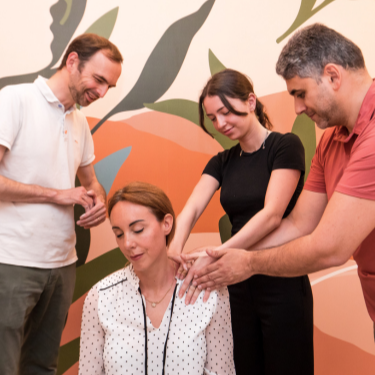
With up to 14 participants, this course incorporates a partner rotation at the end of each module. Each rotation offers a new experience, both giving and receiving - and exposes everyone to a diversity of touch styles, body types and comfort levels.
This is one of the most valuable contributions of a face-to-face course, which an online course cannot replicate.
The rotation is announced by a simple instruction: "It's time to find a new partner." With 13 participants (7 pairs with the initiator), a standing circle rotation works very well: those giving stay in place, those receiving move forward one position clockwise.
This maintains the group's energy and avoids the potentially awkward social aspect of "choosing" partners.